You put them in the moment you leave the house. On the commute. At the gym. Walking to the shop. Sitting at your desk. Sometimes you are not even playing anything. They are just in.
A signal to the world — and to yourself — that you are elsewhere. But your nervous system is always exactly where your body is. And it has been trying to tell you something.
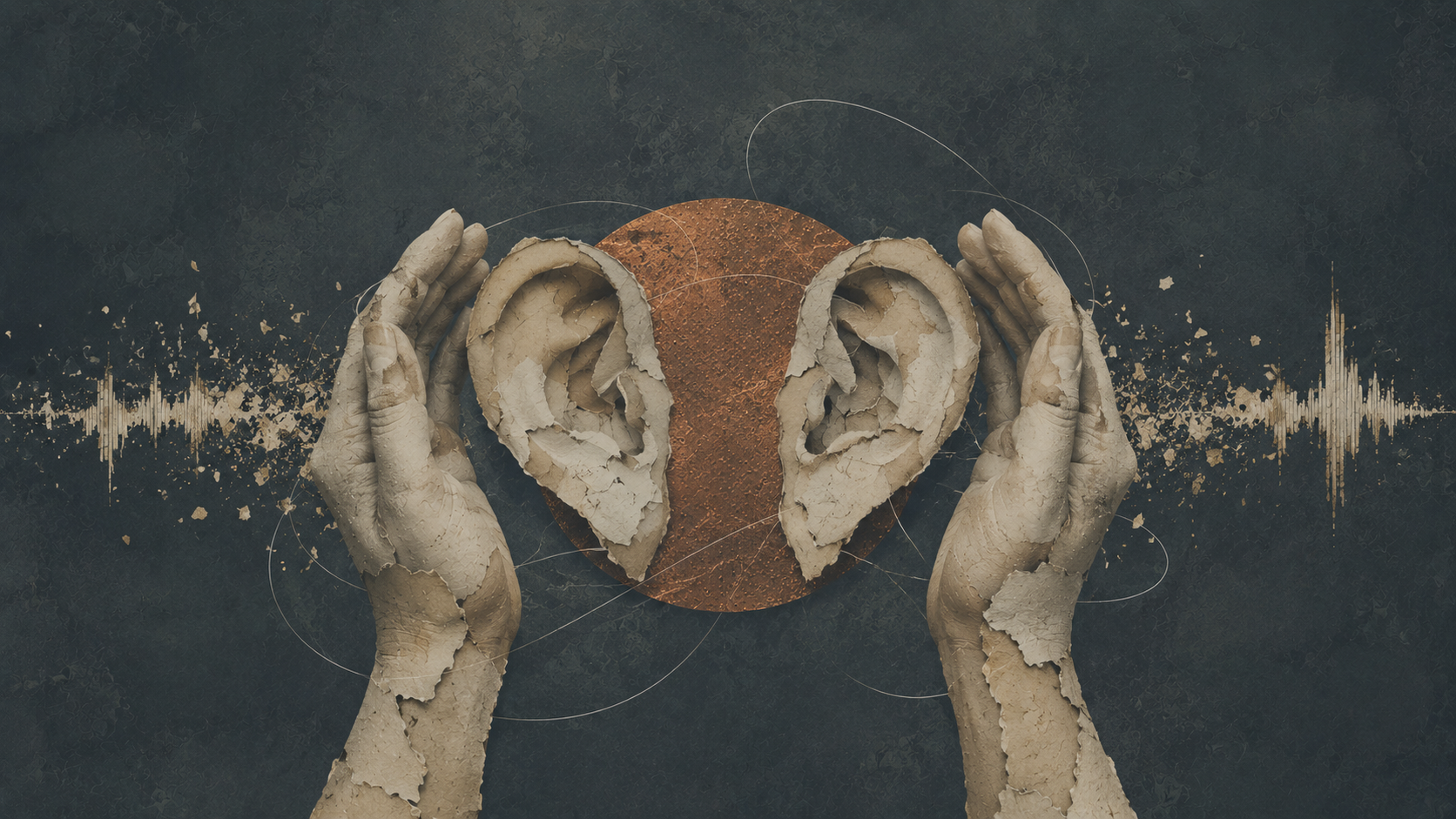
The Quiet Danger of Always Having Earphones In — A visual anchor in the quiet stillness.
The Ear Was Never Designed For Silence
Evolutionarily, your ears are your primary early warning system. They don't have lids for a reason. They are always on, always scanning for the snap of a twig or the shift of the wind.
The brain uses ambient sound to regulate the nervous system. Background noise isn't just "noise"; it's data. It tells your brain that the environment is stable, that you are part of a larger ecosystem.
Take a breath. You're still here.
When you block this out with silicon tips and noise-cancellation algorithms, you are effectively blinding one of your most vital senses. The brain loses its spatial awareness, and your baseline stress levels begin to creep upward.
What You Are Actually Blocking Out
You think you are just blocking out the traffic or the office chatter. But you are also blocking out the social cues, the weather shifts, and the rhythm of the world around you.
These natural soundscapes are essential for nervous system regulation. Without them, you enter a state of sensory deprivation in slow motion. The brain stays on high alert because it can no longer "hear" safety.
This creates a mental state of constant, low-level vigilance. You are physically safe, but your nervous system is suspicious. It is waiting for the threat it can no longer listen for.
The Identity Shift of Permanent Audio
Constant audio input changes your relationship with your own thoughts. When the world is always narrated by a podcast or a playlist, you never have to sit with your own internal monologue.
For heavy earphone users, silence eventually begins to feel threatening. It is no longer a space for reflection; it is a vacuum that needs to be filled. The inability to be bored is a significant cognitive cost.
Let your shoulders drop. There is nothing to do right now.
Audio becomes a form of emotional avoidance. We use sound to drown out the feelings that only surface in the quiet. But those feelings don't disappear; they just wait for the battery to die.
What Constant Audio Does to Your Brain's Resting State
The brain has a "resting state" known as the Default Mode Network. This network is where creativity happens, where we process our identity, and where we find solutions to complex problems.
Constant audio input suppresses this network. By keeping the brain focused on external sounds, you prevent it from doing its essential internal work. The brain needs acoustic rest just as much as it needs sleep.
Cognitive restoration theory suggests that natural, ambient environments help us recover from mental fatigue. By replacing the wind and the birds with a podcast, you are denying your brain its primary recovery tool.

The Sound of Being Somewhere
There is a profound neuroscience to place attachment. We "feel" like we are somewhere not just because of what we see, but because of what we hear. The reverb of a room, the hum of a street.
Exhale completely. Let the noise fade away.
Removing ambient sound disconnects you from physical presence. You are walking through a neighborhood, but you are psychologically in a studio in Los Angeles or a concert hall in London.
This fragmentation of experience leaves us feeling unmoored. The sensory richness of unmediated experience is what makes life feel "real." Without it, the world becomes a backdrop instead of a home.
Nobody is saying throw them away.
But there is a version of your day that exists between the music and the podcasts and the noise cancellation.
A version where you are actually in the street you are walking down. Actually in the room you are sitting in. Actually present in the five minutes between one thing and the next.
That version does not require anything from you except the willingness to hear what is already there.